
BESS Maintenance in Hawaii
What Every C&I System Owner Should Demand
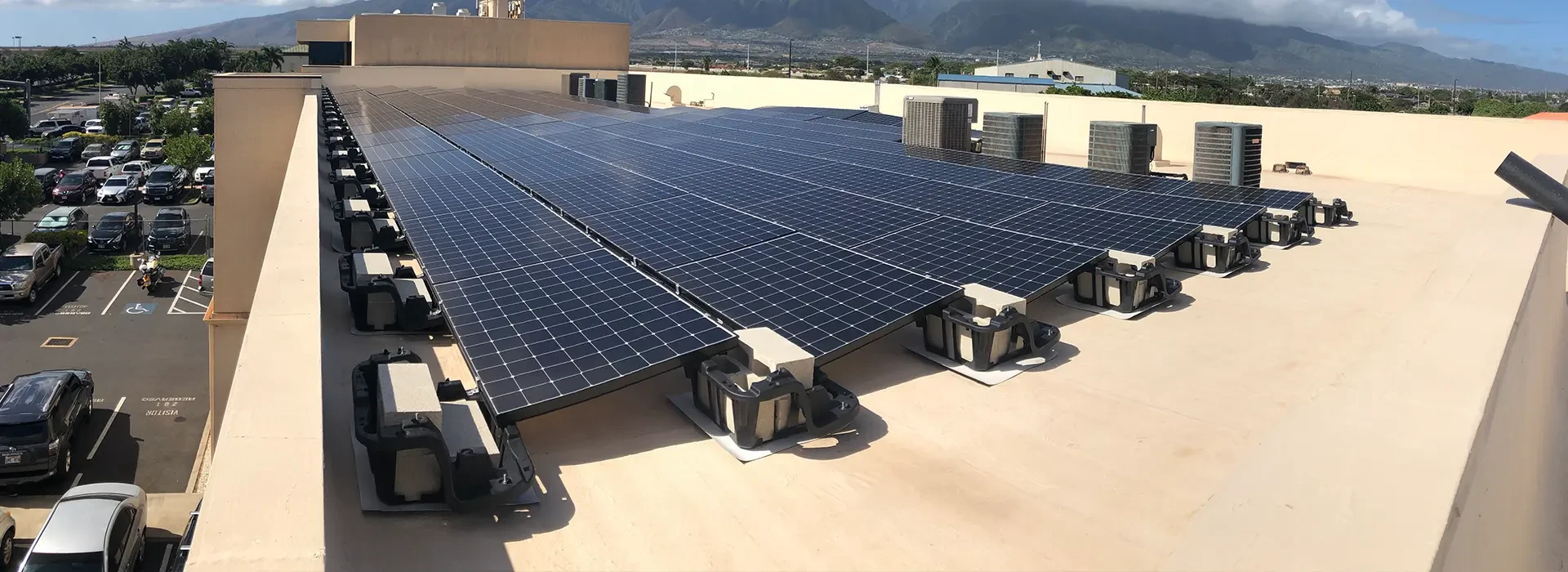
Hawaii has more battery energy storage capacity per capita than almost anywhere in the United States. Driven by the state's 100% renewable energy mandate and the highest electricity rates in the nation, C&I owners across the islands have invested heavily in BESS to reduce demand charges, provide backup power, and participate in grid services programs. But a BESS that isn't maintained correctly doesn't just underperform — it degrades faster, poses safety risks, and can void manufacturer warranties. Here's what rigorous BESS maintenance looks like in Hawaii's unique environment.
Why Hawaii Is Uniquely Demanding for BESS
Battery chemistry is sensitive to temperature, humidity, and corrosive environments — and Hawaii delivers all three in abundance. Ambient temperatures in industrial and rooftop enclosures can exceed 100°F during summer months, accelerating cell degradation if thermal management systems aren't functioning correctly. Coastal salt air penetrates enclosure seals and attacks electrical connections, bus bars, and structural components. High humidity — often exceeding 80% relative humidity in coastal areas — creates condensation risk inside enclosures, particularly during temperature swings between day and night. On the Big Island, volcanic emissions add sulfur compounds to the atmosphere that are corrosive to copper and aluminum components. A BESS maintenance program that doesn't account for these Hawaii-specific stressors is leaving performance and lifespan on the table.
The Core Elements of a Rigorous BESS O&M Program
Thermal management inspection is the highest-priority item in any Hawaii BESS maintenance program. HVAC units, cooling fans, and thermal management systems must be inspected and serviced on a schedule calibrated to Hawaii's ambient conditions, not the manufacturer's mainland baseline. A failed cooling system in a Hawaii summer can cause irreversible cell damage within hours. Battery management system (BMS) monitoring requires continuous data review, not just alarm response. State of charge, cell voltage balance, temperature differentials, and state of health trends need to be tracked over time to catch degradation before it becomes a capacity or safety issue. Enclosure integrity checks covering seals, gaskets, drainage, and ventilation are critical in Hawaii's humid, corrosive environment. A compromised enclosure seal that would be a minor issue in a dry climate becomes a serious corrosion and moisture ingress risk in Hawaii. Electrical connection inspection covers bus bars, cable terminations, and grounding systems. Salt air and humidity accelerate oxidation at connection points, increasing resistance and creating hot spots that reduce efficiency and create fire risk. Fire and safety system verification ensures that suppression systems, gas detection, and emergency disconnect systems are functional. This is non-negotiable for any occupied or high-value facility.
Warranty Protection and Documentation
Most BESS manufacturers require documented maintenance records as a condition of warranty coverage. A maintenance program that doesn't produce auditable records, including inspection reports, BMS data exports, and corrective action logs, leaves C&I owners exposed if a warranty claim becomes necessary. Beyond warranty protection, good documentation gives you the data to make informed decisions about capacity augmentation, technology repowers, and end-of-life planning. A BESS that has been properly maintained and documented has measurably higher residual value than one that hasn't.
BESS Repowers and Technology Upgrades
Battery technology has advanced significantly over the past decade, and many C&I systems installed in Hawaii's early storage boom are now candidates for capacity augmentation or full repowers. A qualified O&M provider should be able to assess your system's current state of health, model the economics of augmentation versus repower, and execute the work, not just flag the issue and hand you off to a separate contractor. Obsidian Hawaii provides full-scope BESS reworks and repowers as part of our C&I services, so the team that maintains your system is also qualified to upgrade it.
What to Ask Your BESS O&M Provider
Before signing a BESS maintenance contract, ask: What is your thermal management inspection interval, and how is it calibrated to Hawaii's ambient conditions? Do you provide continuous BMS monitoring or only scheduled inspections? What is your documented response time for a thermal event or BMS alarm? Are your field technicians BESS-certified and OSHA 30 compliant? Can you provide sample maintenance reports from comparable Hawaii C&I installations? A provider that can't answer these questions with specifics is not equipped for Hawaii's BESS environment.
Obsidian Hawaii's BESS Capabilities
Obsidian Hawaii's field teams are BESS-certified and OSHA 30 compliant. Our BESS maintenance programs are built around Hawaii's actual environmental conditions, not mainland templates. We provide continuous monitoring, documented inspection reports, and full-scope corrective and preventive maintenance across the Hawaiian Islands. When your system needs more than maintenance, whether augmentation, repower, or decommission, we have the capability to execute the full scope of work.
Is Your BESS Getting the Maintenance It Needs?
Contact Obsidian Hawaii for a BESS health assessment and maintenance program review.
Contact Us