
Why Solar O&M Is Different in Hawaii
And What C&I Owners Need to Know
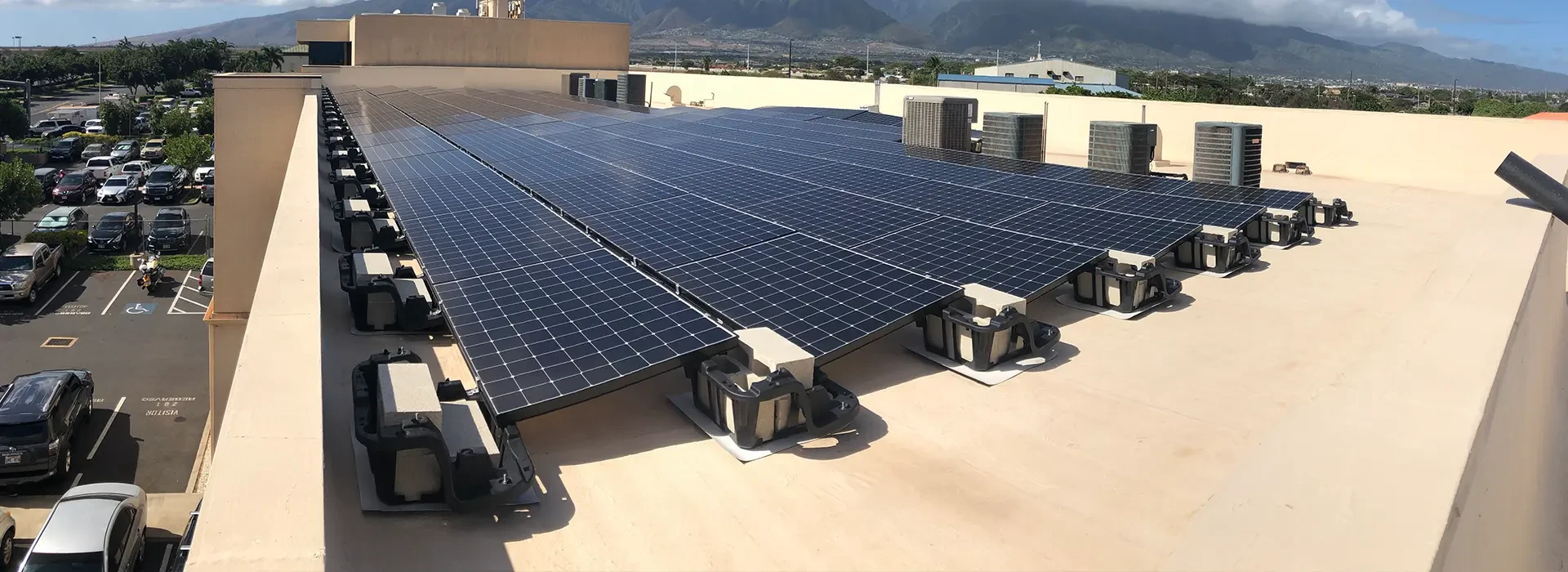
If you own or operate a commercial or industrial solar system in Hawaii, you already know the islands don't play by mainland rules. The same environment that makes Hawaii one of the best solar markets in the country — intense sun, consistent trade winds, high electricity rates — also makes it one of the most demanding for long-term system performance. A solar O&M program designed for Arizona or California will leave gaps that cost you in Hawaii.
The Hawaii Environment Is Hostile to Solar Hardware
Salt air is the first threat most C&I owners underestimate. Coastal and near-coastal sites across Oahu, Maui, Kauai, and the Big Island expose racking, wiring, connectors, and inverter enclosures to accelerated corrosion. A connector that lasts 20 years on the mainland may fail in five without the right materials spec and inspection cadence. Vog, volcanic smog from Kilauea and other active vents, deposits sulfur dioxide and particulate matter on panel surfaces across the Big Island and, during Kona wind events, as far as Oahu. Unlike dust, vog residue is chemically reactive and bonds to glass surfaces differently than standard soiling. Cleaning protocols that work for dust don't fully address vog contamination. High UV intensity compounds degradation of encapsulants, backsheets, and junction box seals faster than temperate climates. An O&M provider that isn't calibrating inspection intervals to Hawaii's actual degradation rates is working from the wrong baseline.
What a Proper Solar O&M Program Includes
A rigorous C&I solar O&M program in Hawaii covers six core areas. Preventive maintenance, including scheduled cleaning, torque checks, thermal imaging, and visual inspection, should be calibrated to site-specific soiling rates, not a generic quarterly schedule. Performance monitoring means continuous data review, not just alarm response. Degradation trends, clipping events, and string-level anomalies need to be caught before they compound. Corrective maintenance requires fast response and local parts inventory. Multi-island logistics mean that a provider without island-specific resources will leave your system underperforming while they wait for parts to ship. Thermal imaging with a calibrated IR camera identifies hot spots, bypass diode failures, and cell-level defects invisible to the naked eye. This should be a standard annual deliverable, not an upsell. Inverter and combiner box inspection covers the electrical infrastructure that converts DC to AC, the highest-value and highest-risk components in the system. Documentation and reporting gives you the data to make informed decisions about repowers, warranty claims, and insurance coverage.
Multi-Island Logistics: The Hidden O&M Cost
Hawaii's geography is an O&M multiplier. Serving systems across Oahu, Maui, Kauai, and the Big Island means inter-island travel, coordinated scheduling, and relationships with qualified island-specific contractors. The right O&M partner doesn't just show up when something breaks. They maintain vetted contractor relationships on each island so that when work is needed, there's a single point of accountability coordinating the response, not a fragmented list of vendors the owner has to manage themselves. For C&I owners with assets on multiple islands, this distinction matters. A provider that treats each island as a separate engagement with no coordination layer leaves you holding the accountability that your O&M contract should be carrying.
What to Demand from Your O&M Provider
Before signing an O&M contract, ask for: a site-specific maintenance plan that accounts for your location's soiling profile and corrosion exposure; annual thermal imaging as a standard deliverable; documented response time commitments by island; OSHA 30 certification for all field personnel; and a reporting format that gives you performance data you can actually use. A provider that can't answer these questions with specifics is working from a generic playbook that wasn't written for Hawaii.
Obsidian Hawaii's Approach
Obsidian Hawaii was built specifically for Hawaii's C&I market. Our field teams are OSHA 30 certified, our O&M programs are calibrated to island-specific conditions, and we coordinate across the Hawaiian Islands using vetted local contractors where needed, with Obsidian Hawaii as the single point of accountability throughout. We don't hand you a contractor list and walk away. If your current O&M provider can't tell you the last time your system had a thermal imaging inspection or what your site-specific soiling rate is, it's time to ask harder questions.
Ready to Upgrade Your Solar O&M Program?
Talk to Obsidian Hawaii about a site-specific O&M assessment for your C&I solar system.
Get in Touch